
Accelerator Report: Excellent performance at the LHC
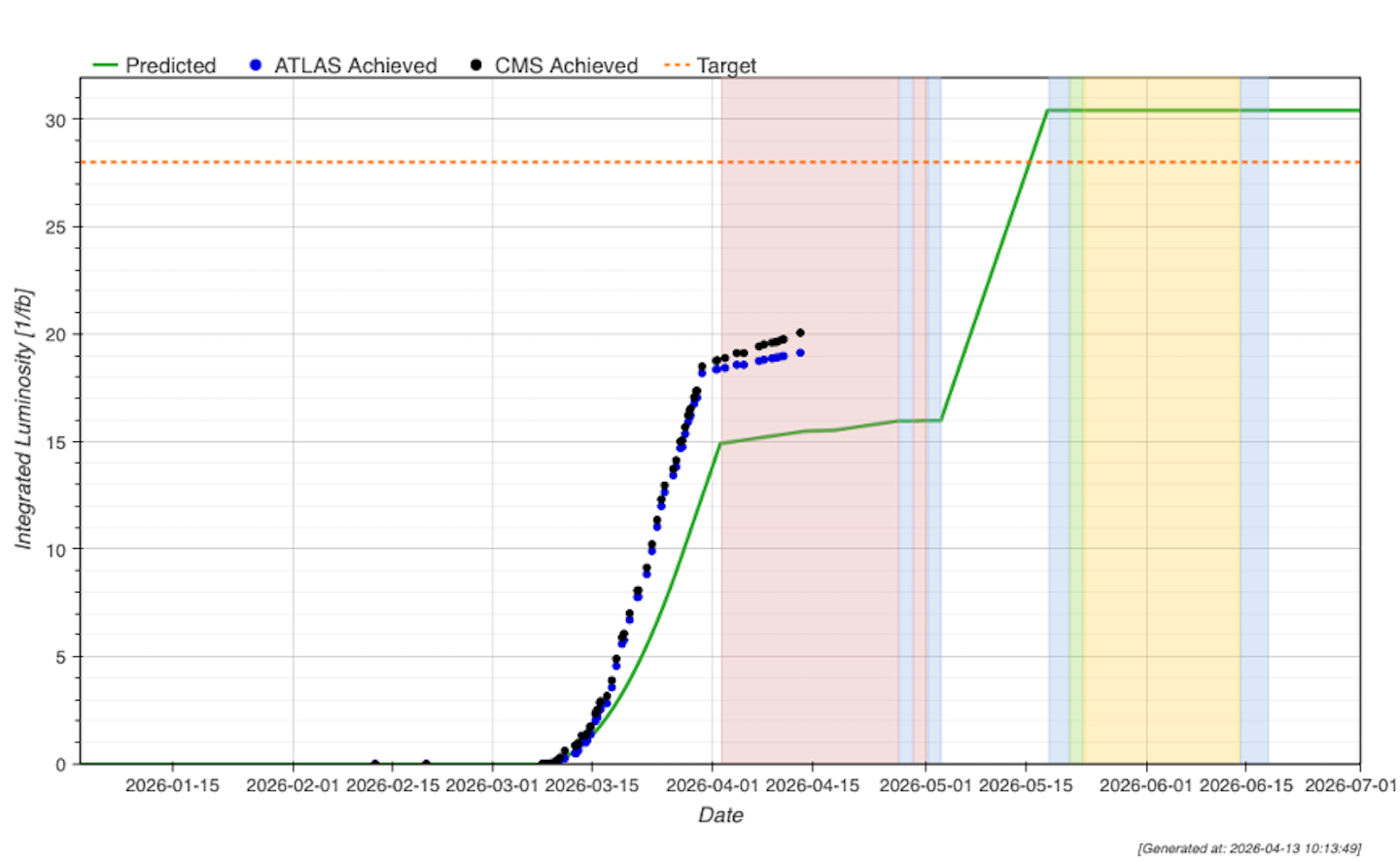
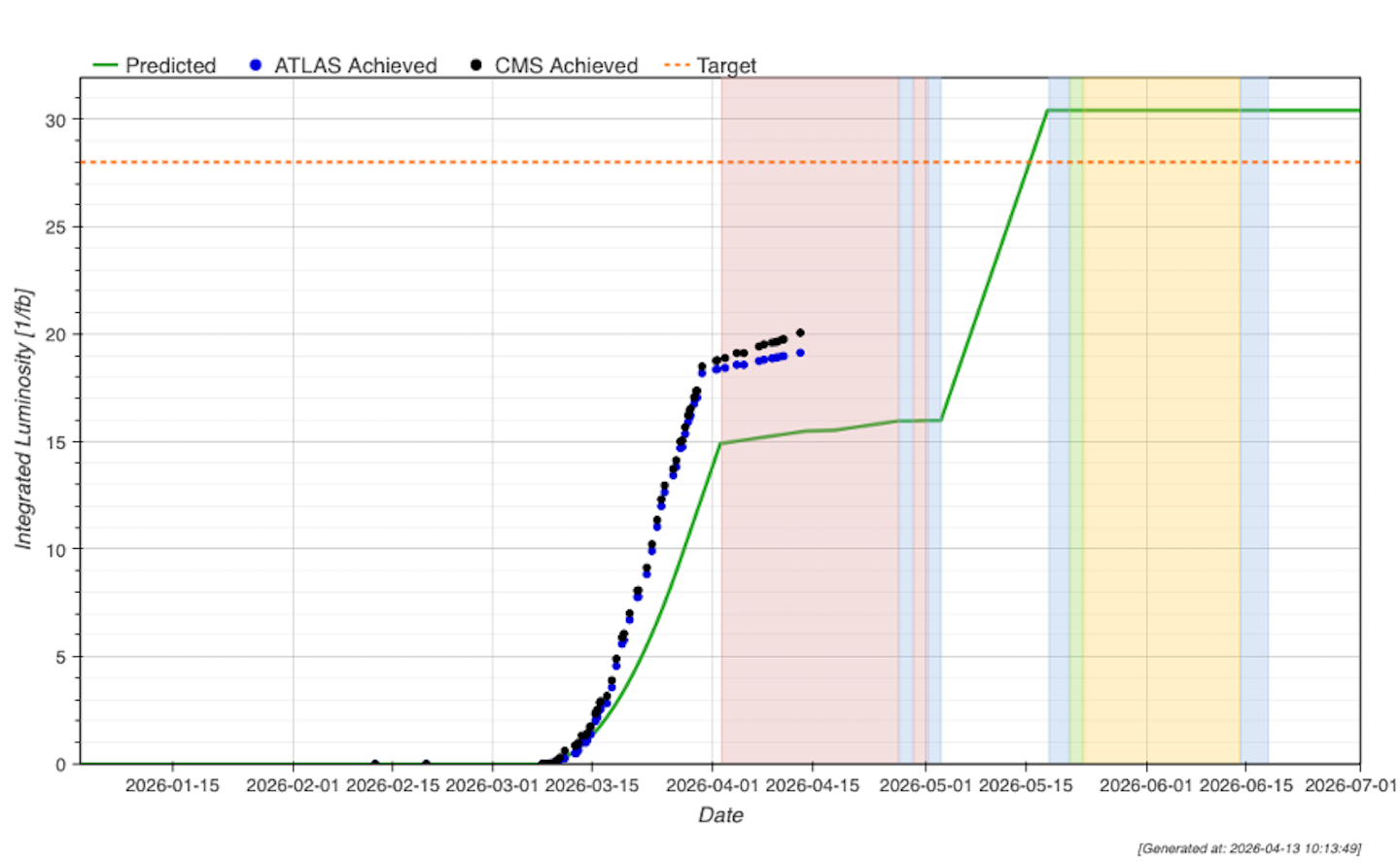
The LHC has successfully reached its nominal Run 3 performance, marking an important milestone in the 2026 physics programme. The intensity ramp-up phase was completed at the end of March, with the machine routinely operating at 1.8×10¹¹ protons per bunch in each beam. Following this achievement, the LHC entered a period of stable physics production for about a week, during which the machine delivered performance that significantly exceeded expectations (see figure).
After this initial high-performance period, the LHC has now entered a dedicated three-week run with reduced pile-up conditions, which means a lower average number of collisions per bunch crossing (the so-called low-μ run). This special mode of operation is an integral part of the 2026 proton–proton physics programme and has been requested by the ATLAS and CMS collaborations to allow them to perform high-precision measurements under optimised experimental conditions.
In standard LHC operation, each bunch crossing typically results in around 64 simultaneous proton–proton interactions. By contrast, the number of interactions per crossing is significantly reduced during the low-μ run. These conditions provide a much cleaner experimental environment, allowing improved control of detector effects and a significant reduction of background noise. Owing to the reduced collision rate, this mode of operation involves particularly long fills lasting up to 50 consecutive hours.
This dedicated data-taking period is primarily motivated by the goal of high-precision measurement of the W boson mass. Achieving the target level of precision requires excellent control of the collision reconstruction, in particular for the hadronic recoil and the missing transverse energy, both of which are significantly improved in low-pile-up conditions. More broadly, the low-μ dataset will also enable a wide range of precision measurements, including studies of electroweak, heavy-flavour and diffractive physics.
A dedicated Van der Meer (VdM) run to provide data for absolute luminosity calibration was initially scheduled to take place during this period. The VdM method consists of transversely sweeping the two beams across each other while measuring the collision rate as a function of their relative displacement. This allows a precise determination of the absolute luminosity scale, ensuring that all subsequent measurements can be normalised with high accuracy.
Such calibration runs require specially prepared beams, with well-defined transverse profiles and controlled intensities. Producing these beams involves a dedicated scheme across the entire injector chain. In the PS Booster, this includes techniques such as controlled tune settings, multiple scattering on the stripping foil and adjustments of the injection trajectory. The beam is then transferred to the PS, where injection oscillations must be carefully minimised. Finally, in the SPS, a dedicated manipulation known as “shaving” is applied to shape the beam distribution before injection into the LHC. These preparatory steps typically require several days of dedicated beam time ahead of the calibration run itself.
However, an unforeseen issue in the LHC cryogenic infrastructure has required a short interruption of operations. One of the warm screw compressors in the station at Point 18, which had already shown elevated vibration levels in recent weeks, exhibited signs of rapidly evolving bearing degradation. In the last few days, the vibration levels increased further and became less stable, indicating a growing risk of significant damage.
To mitigate this risk and protect the integrity of the compressor station, it was decided to bring forward the replacement of the unit, which had originally been planned for the technical stop in May. This intervention was performed early this week, resulting in a three-day stop of the LHC.
Meanwhile, in the injector chain, the availability of the PS was impacted by a major fault affecting the main power supply (POPS). The issue, involving communication and controller failures, required significant intervention by the power converters team. Operation was restored after component replacement and diagnostics. While the root cause is still under investigation, the event highlights the ageing of critical components and the importance of the planned POPS+ upgrade during LS3.
Despite these interruptions, the overall performance of the accelerator complex remains excellent. With nominal intensity reached and dedicated physics runs under way, the 2026 LHC programme is now fully in motion, with further key milestones expected in the coming weeks.
anschaef