
ATLAS sets strong limits on supersymmetry
According to the theory of supersymmetry, there is a mirror world of hypothetical particles that could help resolve several physics puzzles, such as the surprisingly small mass of the Higgs boson and the nature of dark matter. The ATLAS Collaboration at the Large Hadron Collider (LHC) has conducted new searches for these so-called supersymmetric (SUSY) particles using machine-learning techniques. The results of these searches, presented this week at the Moriond conference, have placed some of the strongest bounds yet on the properties of SUSY particles.
Supersymmetry proposes that each particle in the Standard Model has a “superpartner”. The higgsino is the SUSY counterpart of the Higgs boson and is the subject of many SUSY searches. But detecting the higgsino, if it exists, is far from simple. The higgsino would not appear on its own but as a mixture of other SUSY particles, creating states known as neutralinos and charginos. Theorists predict that the lightest neutralino could be stable and, therefore, a strong candidate for dark matter. The other, heavier neutralinos and charginos would decay into this stable SUSY particle. However, these decays are expected to produce very little energy and the resulting low-energy particles would be extremely difficult to detect.
By deploying machine-learning techniques, the ATLAS Collaboration has been able to significantly improve the experiment’s sensitivity to low-energy particles. ATLAS now reports the results of two new searches for signs of SUSY particles in analyses of data from the LHC’s second run, which was collected between 2015 and 2018.
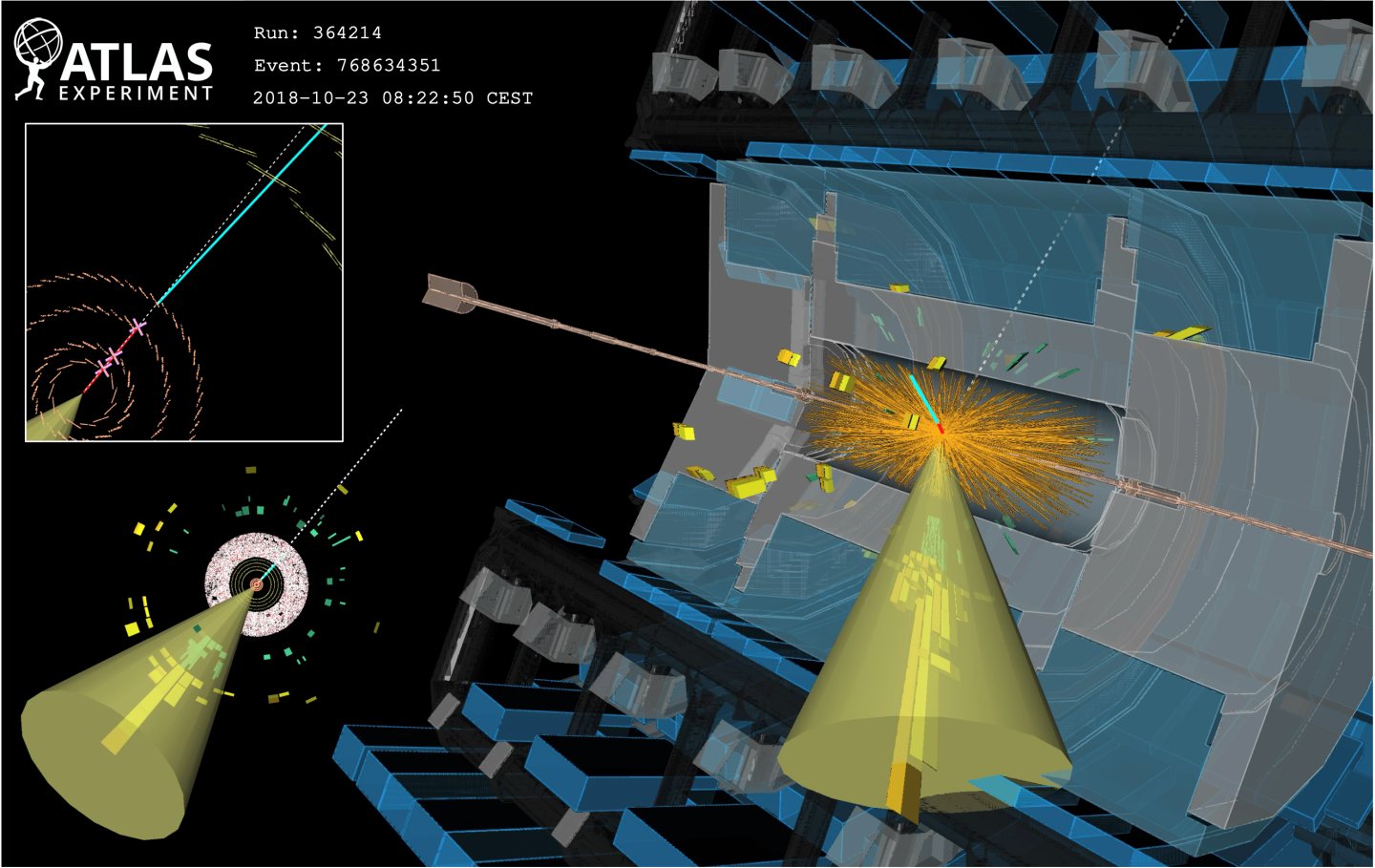
One of these searches involved hunting for signs of a disappearing track left by a chargino decaying into a stable neutralino, which is invisible to the detectors, and a low-energy pion. The pion follows a highly curved trajectory that is extremely difficult to identify in a busy proton–proton collision, causing the chargino’s track to “disappear”. The ATLAS Collaboration additionally searched for signs of heavier neutralinos decaying into the lightest and only stable neutralino and two low-momentum leptons, such as electrons. The researchers deployed neural networks to search deep into the low-momentum region of pions and leptons to find signs of them being produced through the decay of SUSY particles.
No signs of these SUSY particles were observed in either of these searches. However, these results have now set some of the most stringent limits yet on the masses and lifetimes of charginos and neutralinos, superseding the longstanding limits set by the Large Electron–Positron Collider, the LHC’s predecessor.
These limits help guide future searches for SUSY particles at the LHC and the High-Luminosity LHC. The search continues for the mirror world of SUSY.
roryalex